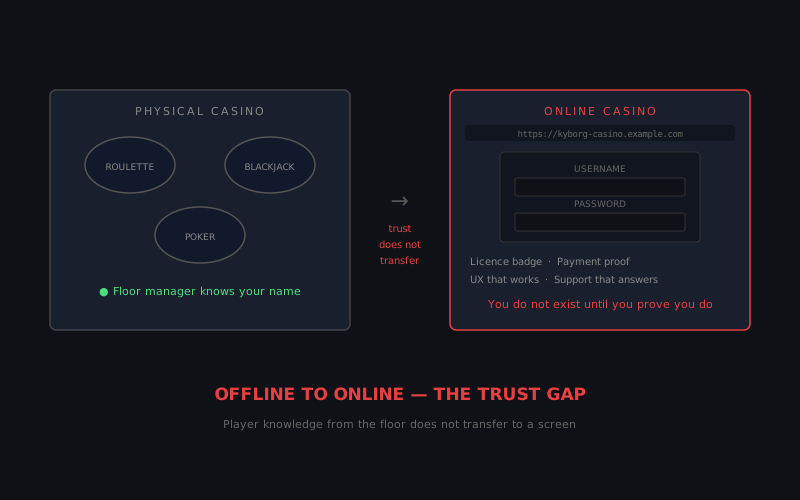
Physical casino operators enter the digital market with a specific confidence: they know their players. Decades of floor experience. VIP relationships. Staff who know names, spending habits, preferences. That confidence is the first thing online corrects.
Player knowledge from a physical environment does not transfer to a digital one. The player who has known your floor manager for eight years does not know your website. Online trust is built through different signals entirely - licence display, payment proof, UX that does not break, a support function that answers. None of these are relationship signals. They are credibility signals. On a screen, you do not exist until you prove you do.
Player behavior changes too. Your highest-value physical customers are not necessarily your highest-value online customers. Session length, spend patterns, game preference, time of day - all of these differ online, governed by different behavioral triggers. Operators who import their physical player value model into their CRM without adjustment are measuring the wrong thing and rewarding the wrong segment from launch day.
Retention mechanics are inverted. In a physical casino you control the environment - the lighting, the ambient conditions, the proximity of the next game. Online, the player controls everything, including when they leave, where they go next, and whether they come back. The levers that work in a physical environment often accelerate churn online. The ones that work online feel counterintuitive to operators trained on the floor.
The first 30 days after launch define your CRM segmentation for months, sometimes years. Most operators do not have a plan for day-one data. They launch, collect data, and build a retention strategy from whatever patterns emerge. This is the wrong sequence. The strategy should precede the data, not follow it.
The technology decisions made at platform selection largely determine what retention tools are available and what data you can actually act on. Platforms built for a different market or operator profile constrain the CRM strategy before it begins. This is worth understanding before the contract is signed - not after the first retention campaign fails.
The channelization question - whether regulated digital markets actually capture the players they are meant to reach - applies to the offline-to-online transition too. Regulation creates the channel. Operators who understand both the physical and digital player create the reason to use it.
The assumption that physical success transfers online is not a strategy. It is a starting budget.