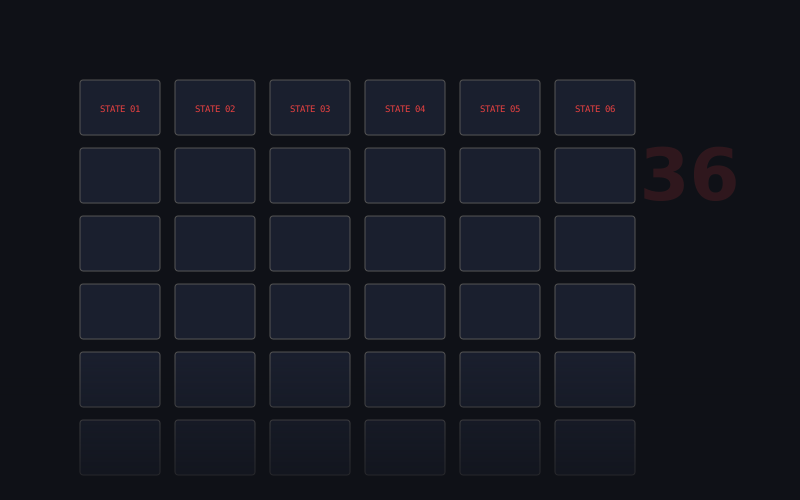
Nigeria doesn't have a gambling regulator.
It has 36 of them.
When the Supreme Court ruled in November 2024 that gaming falls under state authority, the Central Gaming Bill - which would have created a unified national framework - was already dead on arrival. President Tinubu rejected it on constitutional grounds. The Federal Capital Territory kept its National Lottery Regulatory Commission. Every other state got to write its own rules.
The Federation of State Gaming Regulators of Nigeria (FSGRN) published a subnational reciprocity framework in May 2025. Cross-state licence recognition, shared standards, coordinated enforcement. Good intentions.
The problem is that "aligned" and "harmonised" are not the same word.
An operator entering Nigeria now faces: 11% GGR tax (new for 2026), a ₦100 million annual licence fee per state, monitoring-tool integration requirements that vary by authority, and no guarantee that a Lagos licence opens the door anywhere else.
Start with Lagos and you've solved the easiest part of the licensing problem and the hardest part of the commercial problem simultaneously. That is not a strategy. That is a coin toss dressed as a market entry plan.
The real question for any operator evaluating Nigeria is not whether you can get a licence. It is whether your compliance architecture can handle 36 different requirements without rebuilding the stack at each border.
Most platforms can't. Most operators don't find that out until they try to move beyond state two.