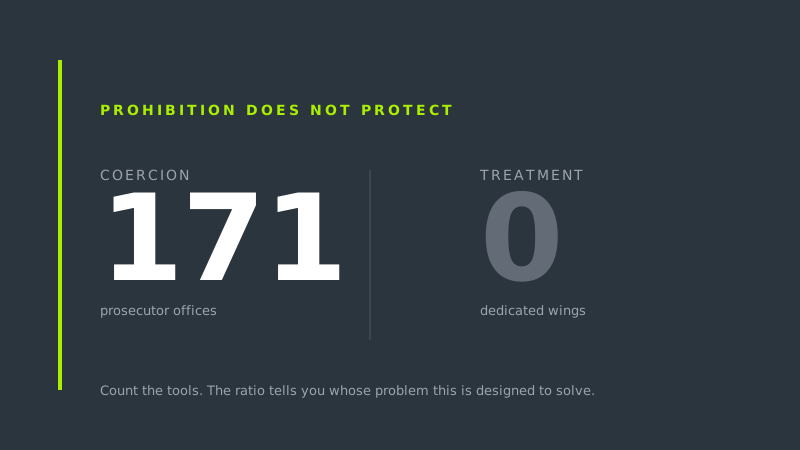
The Architecture Has No Treatment Wing
One hundred and seventy-one chief public prosecutor offices. Eighty-one provincial administrations. Coordination meetings every six months. MASAK as the financial gatekeeper. The 11th Judicial Package with tougher prison sentences, financial penalties, and the power to freeze bank accounts. And as the final layer of the protection infrastructure: Diyanet, Turkey's Presidency of Religious Affairs, delivering sermons about halal income.
This is Turkey's plan to protect vulnerable gamblers.
If you read that sentence and felt reassured, you have not spent enough time watching what happens to problem gamblers when their options disappear. I have. Not from the analyst's chair. From the operator's chair, in markets that tried versions of this and discovered the same thing every time: enforcement protects the state's interests. It does not protect the player who cannot stop.
The article does not need to say this explicitly. The architecture says it for itself. Count the tools of coercion. Count the tools of treatment. The ratio tells you everything about whose problem this is actually designed to solve.
Prohibition Does Not Eliminate Demand. It Relocates It.
This is not a controversial claim. It has been tested at scale, repeatedly, across different substances, different cultures, different centuries. The United States banned alcohol from 1920 to 1933. Consumption did not stop. It moved - to speakeasies, to bathtub gin, to organized networks with no interest whatsoever in product safety. The drinker who wanted a beer on a Friday still got one. He just got it from people who were not accountable to anyone.
Drug prohibition has produced thirty years of the same evidence. The drugs remain. The safety infrastructure around them - dosage consistency, contamination testing, addiction treatment referral - disappears. The casual user weighs the legal risk and often decides it is not worth it. The addict does not make that calculation the same way. Addiction is, by definition, the condition of being less deterred by consequences than the average person.
Gambling prohibition follows the same pattern because the mechanism is identical. The casual player reads about MASAK freezing accounts and decides the risk is not worth the entertainment. Fine. He was never the problem. The problem gambler - the person the whole apparatus claims to protect - does not process the risk the same way. He will find another channel. The channel will be offshore, unlicensed, and completely invisible to any system that might otherwise have caught him.
The 80% figure that Diyanet cites - 80% of Turkish youth exposed to betting content online - is not evidence of a moral failure. It is evidence of a market. You do not dissolve a market by making it illegal. You push it underground and lose the ability to see it.
The Casual Player Stops. The Problem Gambler Doesn't.
This is the distinction that every prohibition framework systematically refuses to make, because acknowledging it would require a completely different policy response.
There is a population of gamblers who engage occasionally, recreationally, without compulsion. They read about tougher penalties, they hear the Diyanet sermon, they decide the entertainment is not worth the exposure. Prohibition works on this population. Congratulations.
There is a second population - smaller, but the one that generates most of the social harm - for whom gambling is not a recreational choice but a behavioral compulsion. Problem gambling is a recognized addiction with neurological correlates. It responds to enforcement the way any addiction responds to enforcement: the behavior does not stop, the behavior moves. The addict does not become less addicted because the legal options have been removed. He becomes more exposed, more isolated, and more invisible to anyone who might help him.
The problem gambler who could previously be identified by an operator's behavioral monitoring system - deposit frequency, session length, loss-chasing patterns - is now playing with an unlicensed offshore operator who has never heard of a responsible gambling department. There are no deposit limits. There is no self-exclusion register. There is no behavioral alert at 3am when he has deposited for the fifth time in an hour. There is no one to call.
Turkey's enforcement apparatus can catch the operator. It cannot help the player. And the player is the one it claims to be protecting.
Sermons Are Not Public Health Policy
The Diyanet statement deserves direct engagement, because it reveals the most important flaw in Turkey's approach - not the enforcement architecture, but the conceptual framework underneath it.
"If there is no legitimate earning, no effort involved, then the resulting gain is not halal." "In gambling, when some win, others lose. When a person wins, they harm someone else; when they lose, they harm themselves."
This is a theological framework applied to what is, in the clinical sense, a public health problem. Problem gambling is classified by the World Health Organization as a behavioral addiction. It has established treatment protocols. It responds to cognitive behavioral therapy, to peer support structures, to controlled re-engagement programs under clinical supervision. It does not respond to being told that the gain is not halal.
The theological framing is not harmless. It actively prevents the policy response that would work. If gambling is a moral failure, the gambler who cannot stop is a moral failure too - someone to be judged and punished, not treated. Shame is the exact wrong clinical environment for addiction recovery. Countries that have made progress on problem gambling rates are the ones that moved gambling from the moral register to the medical register. Turkey is moving in the opposite direction.
The Justice Minister who is now leading this effort is the former Chief Prosecutor of Istanbul who oversaw the arrest of the city's elected mayor. Opposition parties are already noting that the new enforcement infrastructure is well suited to monitoring political opponents. The CHP's observation deserves a separate article. For now, the point is simply this: when the same institutional machinery is doing double duty as political surveillance and player protection, the player protection is not the primary function.
What Actually Works
The evidence base here is not thin. Several European countries have run the experiment with a proper control group - a regulated, competitive legal market alongside structured enforcement against the illegal one - and measured the results.
The United Kingdom has had a licensed, competitive online gambling market since 2005. The Gambling Commission requires licensed operators to implement responsible gambling tools: deposit limits, session time reminders, self-exclusion integrated across operators via GAMSTOP, behavioral monitoring, mandatory referrals to treatment. Problem gambling prevalence in the UK has not increased with legalization. The illegal market has shrunk to a fraction of what it was under prohibition. Because - and this is the mechanism that prohibition advocates never engage with - a regulated operator with deposit limits and self-exclusion is a worse experience for the problem gambler than an unregulated one. The legal channel competes on protection. The illegal channel competes on absence of restriction.
Sweden opened its regulated online gambling market in 2019. Channelization - the percentage of gambling activity flowing through licensed operators - moved above 80% within two years. The operators in that licensed market are required to provide responsible gambling tools as a condition of their license. The unlicensed market did not grow. It contracted.
The Netherlands opened its regulated online market in 2021 after years of prohibition during which the illegal market grew unchallenged. Post-regulation, the legal channel attracted players away from offshore operators. The responsible gambling infrastructure that came with licensing could now be deployed at scale on a visible, accountable player population.
The pattern is consistent. Channelization works. Prohibition does not. The mechanism is always the same: a competitive legal offering with embedded player protection tools is a better proposition for most players than an offshore operator with none of those things. The casual player prefers the regulated channel when it is competitive. The problem gambler is at least visible within it.
Turkey's regulated market - İddaa for sports betting, Milli Piyango for lotteries, Türkiye Jokey Kulübü for horse racing - is not a competitive channel. It is a state monopoly. It does not need to compete. It does not need to be better. It does not need to offer the responsible gambling infrastructure that makes a licensed operator preferable to an offshore one, because it has no incentive to attract players from the illegal market. It only needs to maintain its position as the only legal option.
A state monopoly and a competitive regulated market are not the same policy. They produce completely different outcomes. Turkey is treating them as equivalent. They are not.
The People Turkey Is Not Protecting
Let me be specific about who is left behind when the legal door closes.
The young man in Istanbul who started sports betting during a major tournament and cannot stop. He is now playing with offshore operators because the legal options are inadequate. MASAK is monitoring his transactions. When his account is frozen, he will find another payment method - cryptocurrency, a friend's account, an intermediary. He will not call a helpline, because the helpline exists within a framework that treats him as a criminal, not a patient.
The woman who uses slots as an escape from circumstances that are genuinely difficult. She is not a moral failure. She is a person whose dopamine regulation is working against her. She needs a system that can see her - that can apply friction at the moments of highest risk, that can offer a self-exclusion that actually covers her preferred games, that can escalate to professional support when her patterns become alarming. None of that infrastructure exists in the Turkish framework. The enforcement infrastructure is very good at seeing the operators. It cannot see her at all.
The 80% of young people who Diyanet warns are exposed to betting content. They are being addressed by sermons. The operators reaching them will face prosecutors. The young people themselves - the ones who develop a gambling problem at 17, at 22, at 25 - have no treatment infrastructure designed for them, because treatment infrastructure requires acknowledging that gambling is a medical problem and not a theological one.
Turkey is building a machine that is very good at finding and punishing people. It is not building a machine that is any good at helping them.
The Verdict
Prohibition has a consistent track record and the track record is not good. Not on alcohol. Not on drugs. Not on gambling. The demand does not disappear. It relocates to operators who are less safe, less visible, and less accountable than the ones they replaced.
The vulnerable player - the person invoked in every press release, every ministerial letter, every Diyanet sermon - suffers more under prohibition than under a well-designed regulated market. Not because prohibition is careless. Because prohibition, by its nature, can only see the operators it is trying to remove. It cannot see the players who are left behind.
Turkey's 171 prosecutor offices will catch some operators. The 11th Judicial Package will sentence some of them. MASAK will freeze some accounts. The coordination meetings every six months will produce reports. None of this will reduce problem gambling prevalence in Turkey. Some of it may increase it.
The question that Turkey's policy framework does not ask is the only question that matters: when the enforcement machine is done running, what happens to the player who could not stop?
He is still playing. He is just playing somewhere no one can see him.
That is not protection. That is the absence of it.