On 20 July a Nairobi judge froze Kenya's entire new gambling rulebook. On 7 August he mostly unfroze it. What is still on hold is the part about money. The argument that could have killed the whole instrument went quiet along the way, and almost nobody noticed.
Justice W. Musyoka granted Thomas Buckley Opar Owuor and Ken Brance leave to bring judicial review against the Gambling Control (Licensing) Regulations 2026, and ruled that the grant of leave would itself operate as a stay. That took the entire body of subsidiary legislation out of force. The respondents are Prime Cabinet Secretary Musalia Mudavadi, the Gambling Regulatory Authority and the Attorney General. AGOK and Safaricom PLC sit as interested parties.
The challenge ran on several fronts. The fees, obviously. Inadequate public participation, and a Regulatory Impact Statement the applicants said neither demonstrated real consultation nor assessed what the new fee structure would do to the market. And underneath all of it, whether the Prime Cabinet Secretary had statutory authority to sign subsidiary legislation under the Gambling Control Act at all.
That last one was the dangerous one. A fee is a number a court can adjust. A signature is binary. If the wrong minister made the rules, the rules are void for who made them, before anybody argues about price.
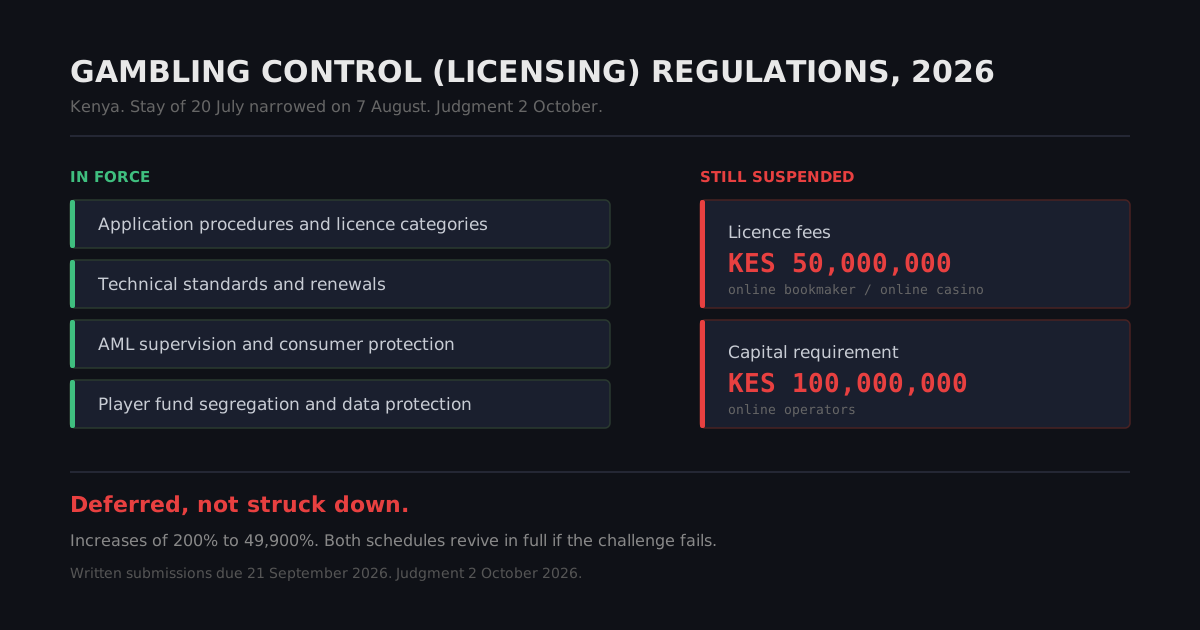
Then the state moved. The government and the GRA applied to lift or modify the stay, arguing through Director General Peter M. Karimi that a total freeze created a regulatory vacuum in which unlicensed operators ran with nobody watching them. On 7 August Musyoka agreed in part. He read the applicants' own statutory statement, observed that their real grievance was the fee schedule, and confined the stay to two things: the licence fees, and the capital requirements. Everything else took effect.
The numbers explain why the money swallowed the argument. A land-based bookmaker renewal moved from KES 5,000 to KES 2.5 million. An online bookmaker or online casino licence now costs KES 50 million on top of a KES 5 million application fee, against a prior regime where the application ran a little over KES 10,000 and the annual licence fee sat between KES 400,000 and about a million. Court documents put the increases at 200 to 49,900 percent. Then a capital requirement of KES 100 million for online operators, and an advertising approval fee pegged at six percent of marketing spend.
Look at what is live today, though. Application procedures. Licence categories. Technical standards. Renewals. AML supervision, consumer protection, player fund segregation, data protection. Every obligation that costs an operator time and systems is enforceable right now. The two things suspended are the two things that cost cash, and they are suspended rather than struck down. If the applicants lose, both come back in full.
That is an awkward place to sit. You build the compliance stack now, to a standard already being enforced, while carrying a nine-figure shilling contingency you cannot spend against and cannot write off. Steve Kipruto David of KDS Advocates told iGB he expects no downward revision of the fees, and doubts a quarter of the more than 150 licensed firms could meet the capital threshold. David Sarinke of McKay Advocates notes the court never said which fees apply in the meantime.
I have sat on the operator side of a licensing reset. The instinct is to model the fee schedule and treat process as background noise. Kenya inverts that. The process argument was the strongest card on the table and it has been parked, not played, while the fee argument runs. Written submissions are due 21 September. Judgment is set for 2 October 2026, delivered through the court's virtual case tracking system.
The GRA got the outcome it asked for. It regulates a live market again, on rules nobody has yet ruled lawful, and the only part still on hold is the invoice. A stay is not a reprieve. It is a deferral with a date on it.