Prince Potemkin built villages along the road to Crimea in 1787, for an audience of one. Catherine the Great was touring her new territory, and Potemkin wanted her to see prosperity that mostly did not exist yet. Freshly painted facades. Livestock moved overnight from the next village down the road. Peasants dressed for the part and told where to stand. Historians still argue about how much of this actually happened. It does not matter. The trick survived because it is real: build the appearance of a thing for someone who will only pass through once, then strike the set the moment the carriage moves on.
Two hundred and thirty-nine years later, the road runs through Hudson Yards instead of Crimea.
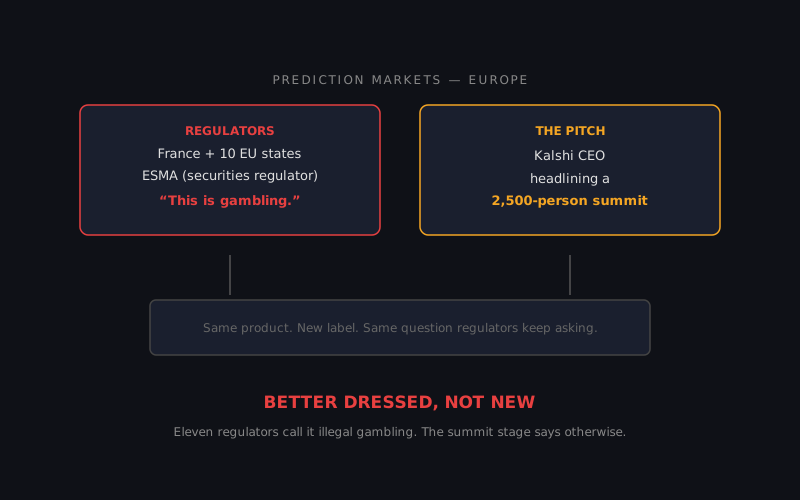
On October 22, two weeks before the US midterms, roughly 2,500 people walk into Hudson Yards for NEXTPredict, the first summit built entirely around prediction markets. Kalshi's CEO headlines. DraftKings' CEO too. Blackstone is there. So is Bloomberg. So is Bank of America. Panels, badges, a step-and-repeat wall, and somewhere in the evening program, a dinner where people who compete with each other all day agree to be photographed smiling at night.
I have sat through enough of these to know exactly what they are for. Legitimacy theater. An industry throws a gala when it wants a category to feel inevitable, permanent, already decided. Nobody holds a summit for something they think might get shut down in six months.
Here is the part nobody on that stage will say out loud. Regulators across Europe already looked at this product. They already called it exactly what it is. France's ANJ classified it as unauthorised gambling back in 2024, then said it again this February, adding that the model creates "an illusion of competence" - dressing chance up as analysis. Spain's DGOJ ordered ISPs to block it in May. Same three gaps that get an offline casino shut down anywhere in Europe: no licence, no age verification, no self-exclusion. Germany. Belgium. Romania. Switzerland. The Netherlands, Poland, Greece, Cyprus, Ukraine, Portugal. All blocked access on the same basis. Four American tribal nations are suing in federal court right now, and the chairman of the Indian Gaming Association already said it better than any regulator has bothered to: "unlawful gambling dressed up as finance."
Nobody invented a new product here. They found a better tailor.
It gets sharper than that. On 17 June, nine European gambling regulators - Belgium, France, Germany, Italy, the Netherlands, Poland, Portugal, Spain and Switzerland - pledged coordinated action against unlicensed platforms for the duration of the World Cup. Then, on 3 July, a second front opened from a direction nobody in prediction markets saw coming. The European Securities and Markets Authority confirmed that a 2018 financial services ban already covers event contracts with binary payouts tied to rates, currencies, commodities, indices, inflation or freight. Derivatives are derivatives, whatever the platform calls them. Marketing or selling one without MiFID II authorisation has been prohibited since 2018. Retail client or not.
Sit with that for a second. This is the industry's own preferred defence - we are not gambling, we are a regulated financial instrument - being tested by the actual regulator for regulated financial instruments. And the answer came back: still not authorised. It does not matter which door you walk through. Gambling law says no licence. Securities law says no licence. Both regulators looked at the same product from opposite ends and reached the identical conclusion, because the product is the same regardless of which argument its marketing department is running that week.
What the licensed side had to build
I spent years on the operator side of this industry, watching what it actually costs to run a book legally. Age verification. Self-exclusion registers. Affordability checks. AML frameworks that get audited, not just published. Advertising standards that took away the exact promotional language that used to convert best. None of it was cheap, none of it was popular internally, and all of it took roughly fifteen years of regulatory pressure to build into something an auditor would sign off on.
The industry also built something less visible: integrity monitoring. Licensed sportsbooks fund the bodies that watch betting patterns for signs someone knew the outcome before it happened. IBIA. Sportradar's integrity unit. Data-sharing agreements with leagues and federations built for one job: catch the moment a market moves because of information the public doesn't have yet. This exists because regulators required it as the price of a licence. Expensive. Unglamorous. And it is the single clearest signal that an operator takes the difference between a fair bet and a rigged one seriously.
Prediction markets carry the identical exposure with none of the infrastructure. Senator Chris Murphy said it as plainly as it can be said: "When you go on Polymarket or Kalshi you assume there's some system in place that is assuring that the bet you are making is not rigged. But all of the bets on government action are rigged because somebody in government knows the outcome." A market on whether a bill passes, whether an agency ruling goes one way, whether a contract gets awarded - the number of people who already know the answer runs into the thousands. Staffers, lobbyists, agency officials, their contacts. Nobody is watching for it, because nobody has been required to.
Betting on an outcome someone else already knows is not a new risk regulation hasn't caught up to yet. It is the oldest one there is. It is the exact failure mode that licensing exists to prevent, in an industry that decided the word "gambling" doesn't apply to it and therefore neither do the obligations.
The steelman, and where it breaks
There is a real argument on the other side and it deserves stating properly, because the sloppy version of my case is easy to knock down. Commodity futures and weather derivatives are also, structurally, wagers on an uncertain future event, and nobody calls a corn farmer hedging a harvest a gambler. Susquehanna and Jump Trading are in these markets for arbitrage and price discovery, not for the thrill. Derivatives on uncertain outcomes have existed under the CFTC for decades without anyone confusing them with a casino.
That argument holds right up until you get to the products actually built into these platforms - contracts on who wins the Super Bowl, the coin toss, March Madness brackets sold with a countdown clock and the phrase "generational wealth" attached to it. A corn future has no licensed twin standing next to it, regulated as gambling, taxed as gambling, required to run affordability checks as gambling, because nobody disputes that betting on a corn harvest is gambling. A bet on a football game does have that twin. It is called sports betting, it is licensed in every jurisdiction operating one, and the licensing exists because everyone - including Kalshi's own early marketing, which once claimed sports betting was "legal in all 50 states" through their product - already agrees on what the activity is.
You cannot argue that sports betting is gambling and also argue that the same wager, repackaged as an "event contract," is a financial instrument. It is the same bet. The only thing that changed is which regulator you report to and which obligations you get to skip.
The honest version already exists
Here is the comparison that should actually embarrass the room at Hudson Yards. Unlicensed crypto casinos - no jurisdiction, no certified RNG, no testing lab anywhere near the code - are common knowledge in this industry. Everyone who has worked platform selection has run into one. Nobody pretends they are anything other than what they are. They do not rent Hudson Yards. They do not put a CFTC chairman's speech on the agenda as a credibility signal. They take a bet, they know it is unlicensed, and the customer who plays there generally knows it too. It is dishonest in exactly one way - the game itself - and honest in every other way that matters.
The prediction market industry runs the dishonesty in the opposite direction. Same product. Functionally the same unlicensed wager. But dressed in a Bloomberg terminal skin, a booth next to Bank of America, and a regulatory sponsor. CFTC Chairman Michael Selig has spent 2026 building exactly that cover. He withdrew the prior administration's proposed ban on political and sports contracts, calling the old approach a "frolic into merit regulation." Good line, wrong direction. In the same year he sued three states and filed amicus brief after amicus brief to make sure no state regulator gets anywhere near this product. Nineteen federal lawsuits, thirty-eight state attorneys general, three Congressional bills, and a federal judge in New York who has already told Kalshi its jurisdictional argument does not hold up - all running in the opposite direction from the one man currently deciding federal policy.
The unlicensed casino never claimed to be a stock exchange. The prediction market never stopped pretending to be anything else.
Who is choosing not to notice
The regulators who called this gambling are on the record. The tribal nations suing in federal court are on the record. What is quieter is the licensed iGaming industry itself, which built the compliance architecture prediction markets are now being congratulated for skipping, and which has mostly chosen to watch the gala from the audience rather than say what it obviously knows. That silence is not neutrality. A licensed operator who spent fifteen years and real money building the exact infrastructure a competitor is now selling as innovation, and says nothing, is not being diplomatic. It is subsidising someone else's shortcut with its own compliance bill.
NEXTPredict sells 2,500 tickets two weeks before an election that several of its own listed contracts will be actively pricing in real time. Everyone walking through that door already knows what product they are buying.
Potemkin's villages only had to hold together until the carriage passed. Hudson Yards runs the same trick for two days instead of an afternoon, with Kalshi's CEO in the courtier's seat and a full house that already knows there is nothing behind the paint. The only open question is who admits it first, with a microphone in hand.