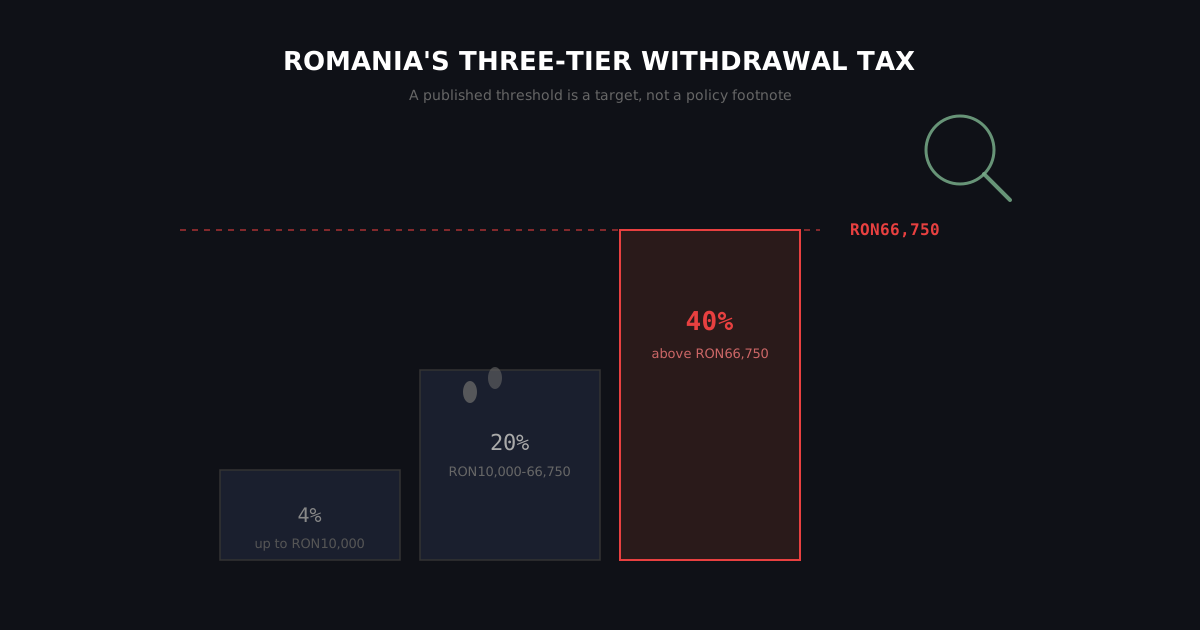
RON66,750. That is the ceiling of Romania's new middle tax bracket on gambling winnings, and whether the Ministry of Finance meant it this way or not, it now reads as a target number for every serious player in the country.
From 1 August, Romania replaced its flat withholding rate on gambling winnings with three tiers. Up to RON10,000 (about EUR2,000), the rate is 4 percent. Between RON10,000 and RON66,750, players owe RON400 plus 20 percent of everything above the lower threshold. Above RON66,750, the rate becomes RON11,750 plus 40 percent on the remainder. The package sits inside a wider fiscal correction: Romania closed 2025 with the largest budget deficit in the EU, 7.9 percent of GDP, well past the bloc's 3 percent ceiling, and Prime Minister Ilie Bolojan's government needed revenue lines that did not require a parliamentary fight over VAT.
Nobody who drafted the ordinance appears to have asked what a clean, published threshold does to withdrawal behaviour. I have spent years building CRM and payout logic for operators licensed in this exact region. A number like RON66,750, printed publicly in a tax law, is not a policy footnote. It is a target. Players who clear that ceiling on a single win will split withdrawals to stay under it. Some will go further and structure repeatedly under RON10,000, taking the 4 percent hit five times rather than the 40 percent hit once. The math rewards patience over honesty, and Romanian players have shown before that they notice when it does.
Operators licensed in Romania, including Fortuna Entertainment Group and Superbet, already run transaction-monitoring systems built for a different job: flagging structuring for AML compliance, not defending a tax bracket from the people it taxes. The detection logic transfers without modification. A government that publishes a threshold this legible has handed its own licensees a second responsibility they never applied for, and a distinction that did not exist before 1 August: telling a player who is managing withdrawal timing apart from a player laundering structured winnings through the identical pattern.
The timing does not help the ordinance's credibility. Romania's gambling regulator, ONJN, spent the same month defending itself against a fresh bribery case: a deputy director general was sought for arrest over allegations she took EUR2,500 to speed up approvals for gambling products, months after a former ONJN president was separately arrested over an alleged EUR100,000 bribe. Two senior officials from one regulator, in a single summer, is not the department a tax authority wants writing thresholds designed to shape behaviour. Separately, and with considerably better optics, Romania's Senate voted 96 to 8 in February to raise the legal gambling age from 18 to 21.
A regulator under its own corruption cloud, designing a tax structure that its own licensees now have to police, is not a compliance failure waiting to happen. It has already happened. The open question is whether ONJN notices the pattern its own tax bracket created before its licensees do.