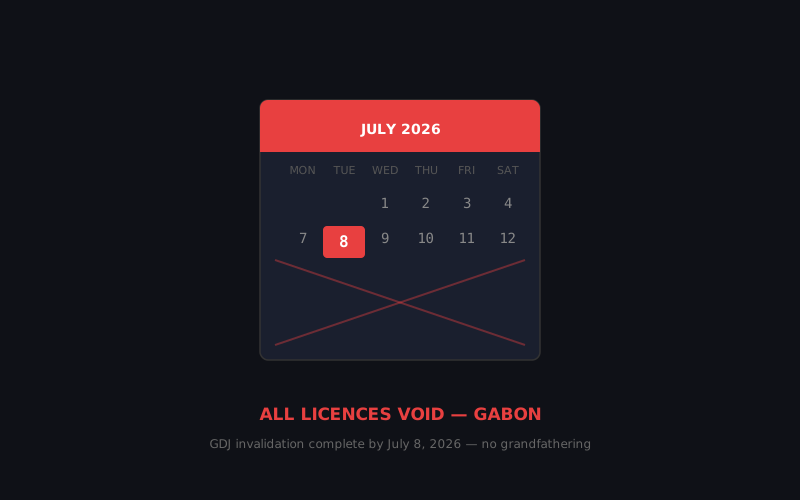
Every gambling licence issued in Gabon before 2026 is dead on July 8.
The GDJ — Direction Générale des Jeux — executed this through two presidential ordinances issued on December 30. The application window for new licences ran from January through March 2. Staggered invalidation began April 7. Completion is July 7.
There is no grandfathering window. There is no transitional licence. Operators either applied in the January-to-March window or they did not. The GDJ knew who was in and who was out before the April 7 deadline passed. The July 7 cliff edge is the visible part of a decision that was taken in early March.
This is worth understanding clearly because it is different from how most regulatory resets work.
The standard model is: announce the new framework, set a transition deadline, allow existing licensees to apply for conversion, enforce from a fixed date. Operators carry forward while the new framework is established.
Gabon's model is: run the application window first, close it before any invalidation begins, then execute the invalidation on a published schedule. By the time operators realised what the December ordinances meant in operational terms, the window had already closed.
The practical effect is that the July 8 date is not a regulatory deadline. It is the publication of a list that was finalised in March.
For operators already in Gabon under a pre-2026 licence: the question is not whether to apply. The application window is closed. The question is whether a commercial presence built on an invalidated licence is a market to exit or a position to restructure under new terms — if new terms are on offer.
For operators evaluating Gabon as a market entry: the new licensing framework is being built in real time. The GDJ has cleared the legacy stack. What comes next is not yet defined.
Markets that reset their licensing architecture entirely are sometimes opportunities. They are always risks. The difference is in what the regulator builds after the cliff edge.