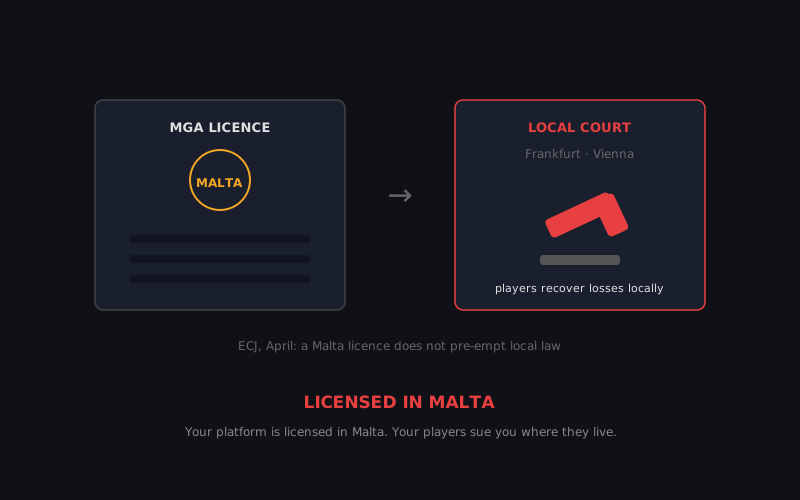
Your platform is licensed in Malta.
Your players sue you where they live.
In April, the European Court of Justice confirmed what national courts in Germany and Austria had been ruling for years: a Malta licence does not prevent a player in Frankfurt or Vienna from recovering gambling losses under local law.
The ECJ was clear. EU law does not preclude member states from banning cross-border gambling services. And where a service was unlicensed under local law - regardless of what Malta issued - players retain the right to reclaim losses in their own courts.
Malta's Bill 55 was the industry's answer to this problem. Drafted specifically to shield Malta-licensed operators from foreign court judgments. The ECJ's Advocate General has since said Article 56A of the Maltese Gaming Act is "manifestly incompatible" with EU law.
Two ECJ determinations in 2026. Both pointing the same direction.
Austria went further. Its Supreme Court ruled in March that executives of offshore gambling operations can be held personally liable - not just the operating entity.
This is what a regulatory arbitrage strategy looks like when it runs out of runway.
Operators who built their EU strategy on the assumption that a Malta licence is a legal position - rather than a product position - are now recalculating. The liability calculus shifts again when it attaches to the individual, not just the company.
Platform selection is not a procurement exercise. It is the moment you decide which legal framework you are willing to operate inside.
That decision is much harder to walk back than a contract.